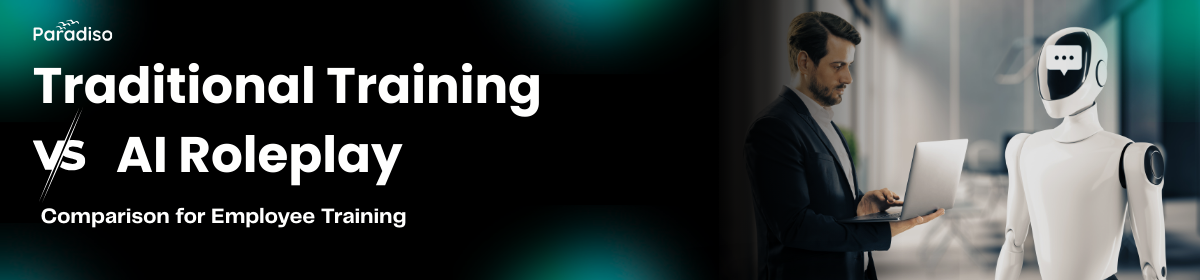



Employee training has always been essential for building skills, improving performance, and driving business growth. For years, organizations have relied on traditional roleplay exercises to simulate workplace situations. While this approach has delivered value, technology is now reshaping how training is designed and delivered.
Today, companies are increasingly exploring AI Roleplay for Employee Training as a scalable, data-driven alternative. But how does it truly compare with traditional roleplay methods? Let’s break it down.
What is Traditional Roleplay in Training?
Traditional roleplay involves two or more employees acting out workplace scenarios. A trainer usually assigns roles such as customer, manager, or employee, and participants simulate real-life conversations.
- Sales negotiations
- Conflict resolution
- Performance reviews
- Customer complaint handling
This method encourages experiential learning and helps employees practice communication skills in a controlled environment. However, traditional roleplay also comes with certain limitations.
Limitations of Traditional Roleplay
1. Inconsistency in Scenarios
Human participants respond differently each time. While flexibility can be beneficial, it also makes training inconsistent. Not every learner experiences the same level of difficulty or challenge.
2. Limited Scalability
Traditional roleplay requires trainers, physical presence (or live sessions), and scheduled time slots. Scaling this across large teams or multiple locations becomes resource-intensive.
3. Subjective Feedback
Feedback often depends on the trainer’s observation. While valuable, it may lack measurable data and structured evaluation metrics.
4. Comfort and Bias Issues
Some employees feel uncomfortable acting in front of peers. This hesitation can reduce authenticity and limit learning effectiveness.
What Is AI Roleplay for Employee Training?
AI Roleplay for Employee Training uses artificial intelligence to simulate real-world workplace conversations. Employees interact with AI-driven characters that respond dynamically based on input, tone, and decisions.
Instead of depending on another human participant, learners practice through digital simulations that are available anytime.
- A sales executive practices objection handling
- A manager conducts a difficult appraisal conversation
- A support agent handles an angry customer
The AI adapts responses in real time, creating realistic and repeatable scenarios.
Key Advantages of AI-Powered Roleplay
1. Consistency and Standardization
With AI Roleplay for Employee Training, every learner experiences structured scenarios aligned with business objectives. Difficulty levels, conversation paths, and evaluation criteria remain consistent across the organization.
This ensures fairness and uniform skill assessment.
2. Scalability and Accessibility
AI simulations can be accessed anytime, from anywhere. There is no need to coordinate schedules or trainers for every session.
Organizations with distributed teams especially benefit from this flexibility.
3. Data-Driven Feedback
One of the biggest differences between traditional methods and AI Roleplay for Employee Training is measurable analytics.
- Response quality
- Communication tone
- Keyword usage
- Confidence patterns
- Improvement over time
This data allows L&D teams to make informed decisions and optimize training programs.
4. Safe and Judgment-Free Practice
Employees can practice repeatedly without fear of embarrassment. There is no peer pressure, which encourages honest experimentation and improvement.
This psychological safety significantly boosts learning engagement.
Comparing Both Approaches Side by Side
| Factor | Traditional Roleplay | AI-Based Roleplay |
|---|---|---|
| Scalability | Limited | Highly scalable |
| Consistency | Variable | Standardized |
| Feedback | Subjective | Data-driven |
| Accessibility | Scheduled sessions | On-demand |
| Analytics | Minimal | Detailed performance tracking |
While traditional methods offer human interaction and spontaneity, AI-powered simulations provide structure, scalability, and measurable outcomes.
Use Case Spotlight: Sales Training
Sales training highlights the difference clearly.
In traditional setups, peers simulate customer conversations. However, the realism depends heavily on how seriously participants act out the role.
With AI roleplay for sales, representatives engage in realistic simulations that replicate pricing objections, negotiation tactics, and competitive comparisons. They can repeat scenarios multiple times until they master responses.
Many organizations now rely on AI roleplay for sales to reduce ramp-up time and increase closing confidence among new hires.
The ability to practice high-stakes situations repeatedly makes AI roleplay for sales particularly impactful for revenue-driven teams.
Blended Learning: The Best of Both Worlds?
- AI simulations for daily skill practice
- Human-led workshops for group discussion
- Coaching sessions for personalized feedback
When integrated strategically, AI Roleplay for Employee Training enhances the trainer’s role instead of eliminating it.
Which One Should Your Organization Choose?
- Team size
- Budget
- Training goals
- Need for measurable analytics
- Remote workforce requirements
For small teams seeking interpersonal bonding, traditional roleplay may still add value. However, for organizations prioritizing scalability, personalization, and measurable performance improvement, AI Roleplay for Employee Training offers a stronger long-term solution.
The Future of Employee Training
Workplace learning is shifting toward personalization, flexibility, and measurable outcomes. Static content and one-time workshops are no longer sufficient.
AI-powered simulations represent a new era of experiential learning where employees actively participate rather than passively consume information.
As technology continues to evolve, AI Roleplay for Employee Training will likely become a core component of modern L&D strategies.
Conclusion
Traditional roleplay has served organizations well for decades. It encourages experiential learning and interpersonal interaction. However, it often struggles with scalability, consistency, and measurable outcomes.
AI Roleplay for Employee Training addresses these gaps by offering structured simulations, real-time feedback, and performance analytics. Whether applied across leadership, customer support, or AI roleplay for sales, this approach empowers employees to practice, improve, and perform with confidence.
In today’s fast-paced business environment, training must be adaptive, data-driven, and accessible – and AI-powered roleplay is helping organizations achieve exactly that.