



HIPAA compliance training is essential for healthcare organizations but building effective training can take considerable time.
AI is changing how organizations approach this process. Training teams can use AI to accelerate content development, personalize learning experiences, create practice scenarios, and identify areas where employees need additional support.
Why HIPAA Training Can Be Difficult to Build
HIPAA training needs to cover more than definitions and policies. Employees should understand how privacy and security requirements affect real workplace situations.
A receptionist, nurse, billing employee, IT administrator, and healthcare executive may interact with protected health information differently.
AI can reduce some of the effort involved in producing these learning assets.
AI Can Speed Up HIPAA Course Creation
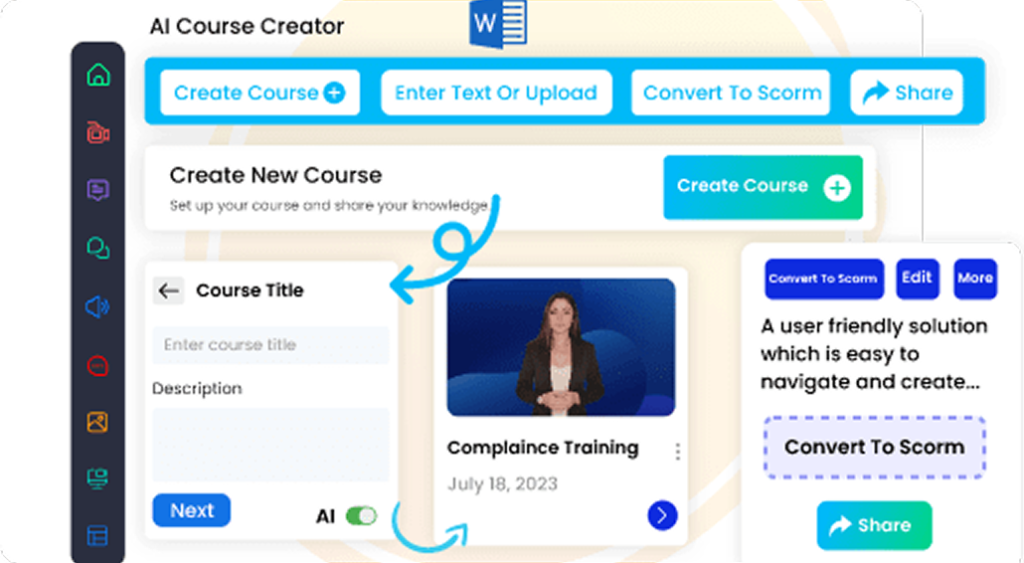
One major advantage of AI is faster content development. Training teams can use AI to turn approved policies and procedures into initial course outlines, lesson structures, summaries, quizzes, and knowledge checks.
The resulting content still needs review by qualified compliance and subject-matter experts, but AI can reduce the time spent starting from a blank page.
Creating More Realistic HIPAA Scenarios
Compliance training becomes more useful when employees can practice applying what they have learned.
AI can help generate workplace scenarios based on situations such as discussing patient information in public areas, responding to inappropriate access requests, handling suspicious emails, or sharing information with the wrong recipient.
Instead of simply asking employees to memorize rules, scenario-based training can ask what they would do next and explain why a particular response is appropriate.
Personalizing Training for Different Healthcare Roles
Not every employee needs the same HIPAA training experience.
AI can support personalized learning by adapting examples, recommendations, or practice activities according to an employee’s role, department, or previous performance.
A front-desk employee may receive scenarios focused on patient conversations and identity verification, while an IT employee may practice situations involving access controls, suspicious activity, and security incidents.
Using AI With a HIPAA-Compliant LMS
AI becomes even more useful when integrated with a HIPAA-compliant LMS. Such a platform can provide a structured environment for delivering training while helping organizations manage learner records, assignments, assessments, and completion tracking.
Within a HIPAA-compliant LMS, AI-supported learning can connect to role-based training programs, automated reminders, assessments, and reporting workflows.
Organizations should carefully evaluate how AI features handle sensitive information. Healthcare organizations should avoid putting protected health information into AI systems unless the system, configuration, contracts, and safeguards are appropriate for the intended use.
Simplifying Assessments and Knowledge Checks
Creating effective quizzes and knowledge checks for every training module can also take time.
It can create multiple-choice questions, scenario-based questions, and knowledge checks that test whether employees can apply concepts rather than simply recall definitions.
Human review remains important. Compliance teams should verify that questions, answers, explanations, and scoring accurately reflect organizational policies and applicable requirements.
Keeping Training Content Easier to Update
HIPAA training is not something organizations should create once and forget.
Policies, technologies, workflows, and organizational practices can change. When training content needs updating, AI can help identify related sections, create revised drafts, and generate new examples or assessments.
This can make maintenance more efficient, while human reviewers remain responsible for approving the final material.
Why Human Oversight Still Matters
Despite its benefits, AI should not be treated as the authority on HIPAA compliance.
AI-generated content can contain errors, oversimplifications, or context that does not match an organization’s policies. Compliance officers, privacy teams, security professionals, and instructional designers still need to review and approve training content.
The strongest approach is to use AI for speed and scalability while keeping human expertise responsible for accuracy, privacy, governance, and final approval.
The Future of HIPAA Compliance Training
AI is making HIPAA compliance training easier to build by reducing repetitive content-development work and helping teams create more personalized, interactive learning experiences.
From generating course outlines and assessments to developing realistic scenarios and supporting content updates, AI can help healthcare organizations build training programs faster while maintaining expert oversight.
When combined with a HIPAA-compliant LMS, AI can become part of a broader training ecosystem that helps organizations deliver relevant learning, track completion, and manage compliance education more efficiently while improving overall learner engagement.
The goal is not to automate compliance judgment. It is to give training teams better tools to create, maintain, and deliver effective HIPAA training in a healthcare environment that continues to evolve.