


WhatsApp Chat
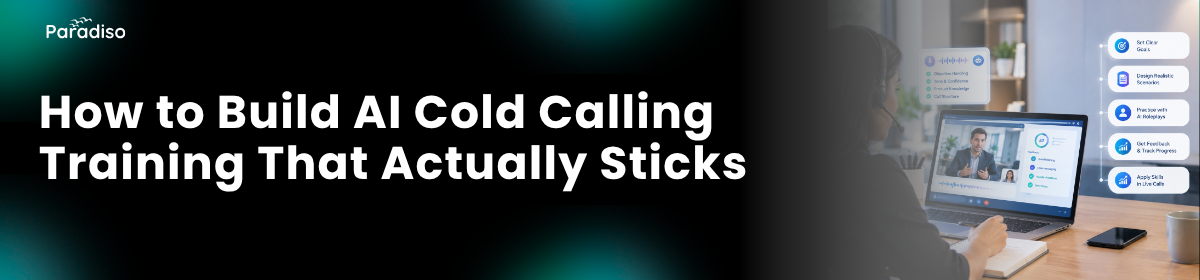
How to Build AI Cold Calling Training That Actually Sticks

How to Build an AI Cold Calling Training Programme That Improves Live Sales Performance

About The Author

Most cold call training programmes fail at the design stage, not the delivery stage. The content is organised correctly. The scenarios look realistic on paper. The reps complete the module and score well on the assessment. Then they dial their first real cold prospect, hear “not interested” in the first eight seconds, and freeze in a way the training never prepared them for.
The design problem is almost always the same. The training taught reps what to say. It did not give them enough repetitions practising it under genuine buyer pressure before the live call where performance matters.

Paradiso AI sales roleplay is built specifically to close this gap. Rather than teaching cold call concepts, it puts reps inside simulated outbound calls with AI buyers who respond dynamically, push back realistically, and score performance against consistent behavioural criteria after every session.

This guide covers how to design AI cold calling training content that produces measurable live call improvement rather than completion-rate statistics your manager does not know how to use.
Free Trial

Practice the hard conversations.

AI Roleplay lets your team rehearse sales calls, customer service, onboarding, and difficult conversations before they matter.

Try Roleplay Free → Free trial, no credit card

Why Most Cold Call Training Modules Do Not Transfer to Live Calls

The most common design mistake in cold call training is building scenarios around cooperative buyers.
A rep completes a module where the AI buyer asks orderly questions, the rep explains benefits in sequence, and the call ends neatly with a meeting booked. The rep scores well. Nothing about that conversation resembles the first real cold call they make the following week.
Real cold prospects are not cooperative. They give short, dismissive answers. They raise objections before the rep has established any value. They name a competitor casually and wait to see how the rep handles it. They cut the call off if the rep sounds scripted in the first sentence.
Training that only exposes reps to cooperative buyer scenarios builds confidence in a situation they will almost never encounter. It does not build resilience for the ones they will.

The Five Structural Elements Every Cold Call Training Module Needs

A buyer persona built from real ICP data, not generic descriptions.

The buyer should have a job title, a set of current business pressures drawn from real customer interviews or call recordings, and a reason they are unlikely to cooperate immediately. A persona that feels generically constructed will produce practice that feels disconnected from real calls.

A clearly defined call stage.

Do not try to cover the full cold call in a single module. Choose one stage: the opening and the first objection, or the gate-keeper screen, or the transition from opening to discovery. Reps who practise one stage thoroughly develop more resilience than those who run through a full call once.

A defined rep objective.

The rep should know exactly what a successful session looks like: earn the right to ask one question, keep the call open past the first objection, or secure a specific next step. Without a clear objective, reps optimise for completing the scenario rather than for the behaviour the scenario is designed to build.

A scoring rubric tied to specific observable behaviours.

Score opening effectiveness, talk-to-listen ratio, objection handling technique, and next-step commitment quality. Do not score overall impressions. Feedback that tells a rep their “discovery was weak” is not actionable. Feedback that identifies the exact moment a rep rushed past an objection without asking a follow-up question is.

Progressive difficulty built into the content sequence.

Start with a buyer who gives slightly short answers and raises one objection. Progress to a buyer who cuts the rep off in the opening sentence, raises two objections, and names a competitor before the rep has said anything about value. Reps who only practise cooperative scenarios develop no resilience for the hardest buyer types they will encounter consistently in live calling.

How to Sequence AI Cold Calling Training Content

The sequencing principle is simple: practise the opening before practising the full call, practise one objection type before adding multiple objections, and practise with progressively harder buyers before going live.
Week one content should focus exclusively on the first thirty seconds of the cold call. Opening line delivery, handling the first “not interested,” and earning the right to ask one question. Nothing else.
Week two introduces the gate-keeper scenario. Earning a transfer to the decision-maker, handling deflections without sounding pushy, and setting the right tone for the conversation that follows.
Week three adds specific objection types pulled from your actual call recording data: “send me an email,” the competitor name-drop, and “call me back next quarter.” Each of these is a separate module with a dedicated scoring rubric.
Week four combines multiple objections in a single scenario and increases buyer difficulty. By this point, reps have enough practice volume on individual moments that the combined scenario feels manageable rather than overwhelming.

For a complete breakdown of how this sequencing model works in practice alongside the full AI cold calling framework, the complete guide to AI cold calling covers the methodology, the Vodafone Idea case study results, and the comparison with traditional cold call training in detail.

Connecting Practice Module Data to Live Coaching

The most underused feature of AI cold calling training is not the practice itself. It is the behavioural performance data the practice generates across repeated attempts.
After a rep completes multiple sessions across your cold call training sequence, you have specific, comparable data on which behaviours improved and which stayed flat. A rep whose opening effectiveness improved across five sessions but whose objection handling score stayed level has a precise development gap, not a general one.
Use that data to direct manager coaching conversations. The module identifies the pattern. The manager addresses the specific behaviour with the rep who needs it rather than running a general cold call training refresh for the whole team.

Conclusion

Building AI cold calling training that produces live performance improvement is a design challenge before it is a technology challenge. The buyer persona, the call stage focus, the rep objective, the scoring rubric, and the progressive difficulty sequence determine whether reps enter their first live dial block prepared or whether they learn cold calling the way most currently do: on real prospects, at real pipeline’s expense.


Get the design right and the platform delivers exactly what cold call training has always needed but has never had a practical way to provide: enough repetitions before performance matters.

Related Posts

Wait!

Your Free AI Authoring Tool is Here.

Request A Quote For Course Catalog

    By submitting this form, you agree to the terms of service, privacy policy and cookie policy, and confirm that the services are for business use only, not personal or consumer use.


    See, why eLearning industry people

    Rank CogniSpark AI no. #1
    Try our AI-Powered Tool today!

      By submitting this form, you agree to the terms of service, privacy policy and cookie policy, and confirm that the services are for business use only, not personal or consumer use.
      Join millions of learners and thousands of organizations!

      See, why eLearning industry people

      Rank CogniSpark AI no. #1
      Try our eLearning Authoring Tool

        By submitting this form, you agree to the terms of service, privacy policy and cookie policy, and confirm that the services are for business use only, not personal or consumer use.
        Join millions of learners and thousands of organizations!
        Try our AI-Powered eLearning Authoring Tool

          By submitting this form, you agree to the terms of service, privacy policy and cookie policy, and confirm that the services are for business use only, not personal or consumer use.

          Register Now