



What Is an AI Employee Training Platform?
An AI employee training platform uses artificial intelligence to personalize, generate, and continuously adapt learning pathways based on real-time performance, rather than relying on static modules that everyone must complete the same way. Think of the difference like this:- A traditional LMS works like a library. The content is organized and searchable, but employees must find what they need themselves.
- An AI-powered platform works like a tutor. It understands what learners know, identifies skill gaps, and recommends the next best learning activity.
The Shift: From Completions to Capability
Traditional corporate training focused on course completion. Today, organizations need employees who can apply knowledge effectively on the job. AI helps organizations move beyond completion metrics by continuously adapting learning and measuring real business outcomes.| Traditional L&D | AI-Enabled L&D |
|---|---|
| Static courses | Adaptive learning pathways |
| Annual content updates | Continuous content improvements |
| Completion rates | Skill development and business impact |
| One-size-fits-all training | Personalized learning experiences |
| Content production | Learning strategy and optimization |
8 Ways AI Is Reshaping Corporate Training
1. Hyper-Personalized Learning
AI recommends learning content based on each employee’s role, current skills, and performance, helping learners focus only on what they need.2. Faster Content Creation
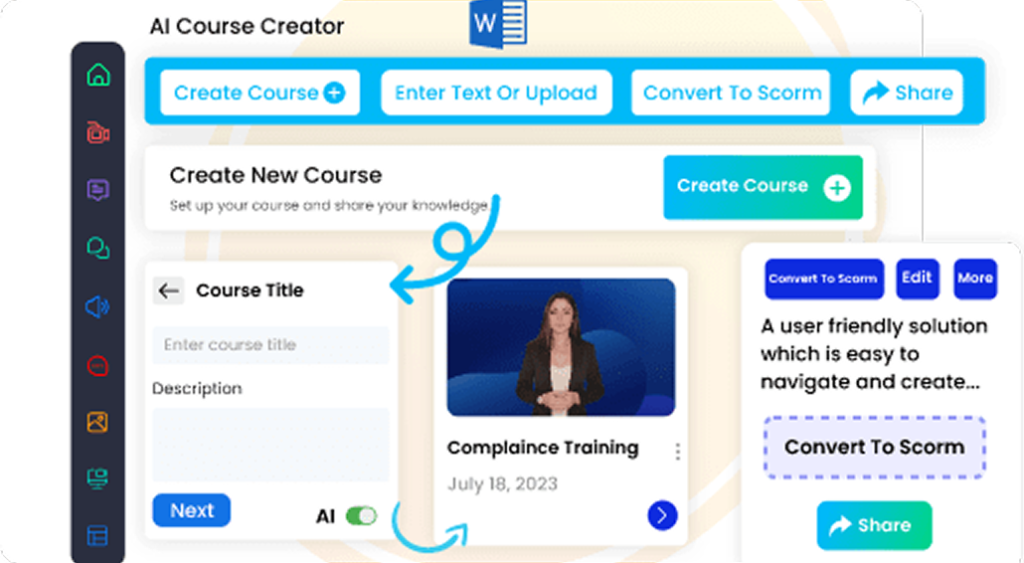
AI converts documents, presentations, and manuals into structured learning content, reducing development time significantly.3. Instant AI Feedback
Employees receive immediate feedback during learning instead of waiting for scheduled assessments.4. Predictive Skill Gap Analysis
AI identifies emerging skill gaps before they begin affecting productivity or business performance.5. Microlearning in the Flow of Work
Short learning modules are delivered when employees need them, improving knowledge retention and reducing disruption.6. AI Roleplay Simulations
Employees can safely practice conversations, customer interactions, negotiations, and compliance scenarios with AI-powered simulations.7. Instant Content Localization
AI quickly translates and localizes training content for global teams while maintaining consistency.8. Internal Career Development
AI connects employee skills with future career opportunities, helping organizations build internal talent pipelines.What the Data Shows
Organizations using AI-powered learning platforms report measurable improvements in employee productivity, engagement, and knowledge retention.- Productivity improvements between 14% and 40%.
- Faster onboarding and quicker employee ramp-up.
- Higher participation in learning activities.
- Better long-term knowledge retention.
How to Evaluate an AI Employee Training Platform
- System Integrations: Connects with LMS, HRIS, and business applications.
- True Personalization: Adapts learning based on real-time learner performance.
- Business Analytics: Measures business outcomes instead of only course completions.
- Security & Compliance: Supports GDPR, CCPA, encryption, and enterprise governance.
- Human Review Process: Allows experts to approve AI-generated learning before publishing.
Common Challenges
Over-Automation
Organizations should avoid publishing AI-generated learning content without human review.Poor Learning Strategy
AI improves delivery but cannot replace organizational learning strategy or business objectives.Lack of Transparency
Employees should understand how their learning data is collected, analyzed, and protected.Implementation Roadmap
Phase 1: Assess Skills
Evaluate current employee capabilities using objective assessments.Phase 2: Launch a Pilot
Start with one department to validate workflows before expanding organization-wide.Phase 3: Build Role-Based Learning
Create learning paths tailored to different roles and skill requirements.Phase 4: Add Human Review
Review all AI-generated training content before publishing.Phase 5: Measure Business Outcomes
Track improvements such as faster onboarding, improved productivity, reduced errors, and employee growth.FAQs
It means training that adjusts to each individual learner — their role, their existing skills, their performance gaps, and their progress — rather than delivering the same content to everyone in a cohort. AI enables this at a scale that was not achievable through manual path-building.
A recommendation engine suggests what to learn next. True AI personalization goes further: it adapts the content itself in real time based on learner performance (adaptive learning), surfaces knowledge at the moment of need within workflows (flow-of-work support), and predicts future skill gaps before they emerge (predictive analytics). Recommendations are one component of a larger system.
No. AI personalization changes how content is delivered and when — it does not eliminate the value of human instruction for complex, context-dependent, or high-stakes learning situations. The most effective implementations combine AI-driven personalization with human-led sessions for learning that requires nuance, relationship, or judgment that technology cannot replicate.
The core inputs are role data, skill assessments, performance records, and prior learning history. The more consistent and complete this data is, the more accurate the personalization will be. Some platforms can generate useful recommendations with basic role profiles; others require deeper integration with HRIS and performance management systems.
Track outcomes, not activity. Relevant metrics include: time-to-competency after training, knowledge retention at 30 and 60 days post-course, manager-assessed performance improvement, learner confidence scores pre- and post-training, and business outcomes tied to the skills being developed. Completion rates measure that learners finished something. They do not measure whether the learning changed anything.
No. Smaller organizations typically start with AI-assisted content creation and role-based content recommendations rather than enterprise-grade adaptive learning and predictive analytics. The entry point scales with organizational size and data maturity. The most important step is to start with the use case most relevant to your current constraints rather than trying to implement everything at once.
Basic deployments with limited integrations can go live in 6–12 weeks. Full enterprise deployments with deep HRIS and LMS integrations and pilot phases typically take 3–6 months. The part organizations consistently underestimate is not the technical setup — it is the time required for data preparation and stakeholder alignment. Both matter more than the software itself.